• Modelers Alliance has updated the forum software on our website. We have migrated all post, content and user accounts but we could not migrate the passwords.
    This requires that you manually reset your password.
    Please click here, http://modelersalliance.org/forums/login to go to logon page and use the "Forgot your Password" option.

Tamiya Spitfire Mk IX (1/32)

I have one of the old Paasche Air Eraser (micro sand blaster) which I have been using to bead blast certain bezels on watches to get the right finish. The thing with the beads is that they are not abrasive, but are round beads and thus don't cut. I might at some point do an experiment to see how it will affect a surface finish if I bead blast the surface paint off.
 
That could work Paul certainly worth a try. As much as the problem of wear is what's underneath and not removing that as well, thats why i experimented with foil as a base as while paint will lift using for instance a n auto rubbing compound it wont lift the foil. I expect it will come down to airbrush skills, its probably easier to spray the finish you want than to spry a finish you dont want and try and alter it :)

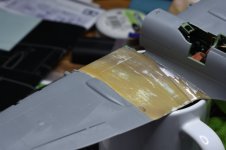
DSC_1682.JPG This was achieved simply wiping with rubbing alcohol. you have a degree of control because while it thins paint when wet the longer you leave it to harden th4e less effect the alcohol has , 15 minutes is all it akes between wiping the paint off and having to rub quite hard to get it off so timing would be key.
A problem with chipping fluid on this job would be the 2 colours and the time frame, you really need to be doing the chipping after about 30 minutes drying, after the top coat goes really hard, say next day its probably not going to chip. If like me you spray the camo as all over green and add the brown disrupter later i doubt it will chip where there are two colours on top of each other
 
I might do some tests sometime down the road on a piece of acrylic or scrap styrene to do the air eraser. I already know that I will have to do a clear coat over the silver base to give a band of forgiveness.
It will be an interesting experiment to say the least.
 
I think i mentioned that i am building this for someone else, its a request :) I'm not going mad on it, you could add a lot to this like any build but its going to be 98% OTB

DSC_1685_01.JPG


DSC_1686_01.JPG

the engine is quite nice, it made up of 50 pieces believe it or not. again you could really detail this with piping and wires

DSC_1705.JPG


Some really large emissions from Tamiya including the ignition wiring and the RR name from the rocker cover, I am told that after market do an ignition loom and PE name plates for the rocker covers .

DSC_1699.JPG


again you could go to town on this but i doubt much would be seen and bear in mind i am going for "war weary" here so its not a plan that really lends itself to picking out detail.
 
Last edited:
Ah, I don't think you mentioned that this was a build for someone. Still looking really good Paddy. If the cowling is to be closed all you need is bare minimum that would be seen on the engine. I have a Bf109 that is in process that you could see the front top of the engine through some openings in the cowling and thus did what was needed to see what should be there.
 
With what I have been working on, something just came to mind, what primer(s) were used on British aircraft during the war? There is always talk about what external colors were used, but what color was the primer under the outer paint? I have a couple of photos of P-38s where the paint is worn down into the red primer underneath. One of these planes is at the Udvar Hazy Smithsonian.

p38-a.jpg


turbocharger.jpg


This is just a thought as you are doing a Spitfire with worn paint.
 
Wow, huge question and a million answers. Primers depended on the material, the manufacturer and the type of top coat
With a cellulose top coat then light sea and mediums sea grey undercoats were common.
Red was typically used on fabric as a shrink coat rather than a primer, you see #red on fabric surfaces like hurricane wings, ailerons rudders etc. its also the reason why gun ports are often red as they would dope fabric over them on fighters. It gets complicated when Bristol used the red as a primer for cellulose on all aircraft when others used grey a whatever they had.

Wzgtiu.jpg


spitfire elevators were fabric till 1944 above

The cockpit green on RAF aircraft was the equivariant of US zinc chromate but not zinc chromate, it was a corrosion inhibitor coating not a finish paint
Wooden aircraft like the Mosquito used a clear or silver tautening dope on the wood and fabric

as a general rule cellulose primer was light or dark grey .........or any other colour available that day :)

On US aircraft oxide paints were common, they tinted it red so it was more obvious when you missed a bit, the navy Tended to towards yellow oxide or zinc chromate.
 
Last edited:
Didn't we just have a video about how to spray al la RAF colors?


I don't recall if colors...sorry ol' chap, Colours are mentioned.
First mention of primer.
 
Back
Top